Pony Express Map
A Monumental Record of America’s Historic Trails
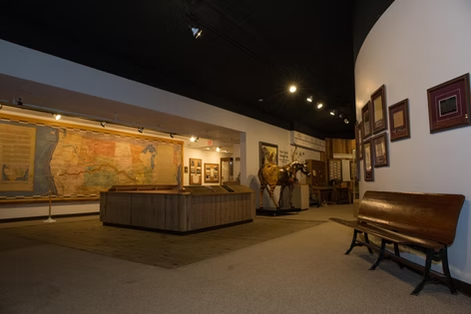
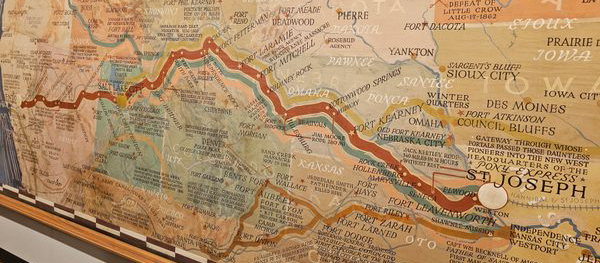
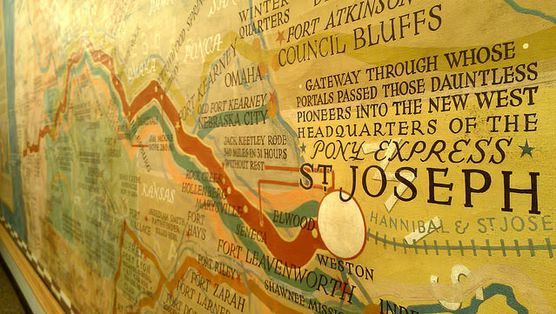
The Pony Express National Museum is proud to preserve The Pony Express Map, a monumental mural by artist George Gray that captures the vast network of trails shaping westward expansion. Originally unveiled on October 15, 1938, in the Crystal Ball Room of the historic Hotel Robidoux, the mural stands as one of the most comprehensive visual records of America’s pioneering routes.
At the unveiling, Eleanor Roosevelt reflected on the mural’s lasting value, noting that its true importance would be realized over time as perspective allowed viewers to appreciate its depth, accuracy, and warmth of color.
A VISION BROUGHT TO LIFE
The idea for the mural originated with General James Leslie Kincaid, President of the American Hotels Corporation, who envisioned creating a permanent painted record of historic trails throughout the Midwest. Under his leadership, George Gray was commissioned to depict military and civic history across the United States through a series of 233 murals installed in hotels throughout the country.
MAPPING THE WEST
In addition to the Pony Express Trail, the mural illustrates numerous historic routes, including the Oregon Trail, California Trail, Santa Fe Trail, Old Spanish Trail, the Lewis and Clark Northwest Passage, the Butterfield Route, and other paths forged by explorers traveling across the continent and beyond.
Months of detailed research were required to ensure historical accuracy. George Gray worked closely with Professor Frank S. Popplewell of St. Joseph Junior College, along with historians in St. Joseph, Columbia, Washington, D.C., and Rochester, New York, to verify every detail.
PRESERVATION THROUGH CHANGE
When Hotel Robidoux was demolished in 1996, the mural was relocated multiple times before its ownership was officially confirmed as belonging to the Pony Express National Museum. Through collaboration among community leaders and preservation advocates, the mural ultimately found a permanent home at the museum.
Three of the four George Gray murals originally created for the hotel are now displayed at the museum. The fourth, featuring a World War I theme, resides in the Donnell Court Building.
RESTORATION AND COMMUNITY SUPPORT
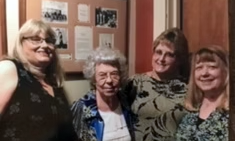
In the mid-1990s, five St. Joseph Questers chapters stepped forward to restore the mural. Local fundraising efforts were matched by Questers International, making the preservation possible. In January 1995, the mural was carefully transported to the museum, where restoration and repair were completed by Tom Duggins of Frame Station.
The successful restoration led to a formal dedication ceremony on April 2, 1995, attended by local, state, and national leaders. A special highlight of the event was the presence of George Gray himself, whose later recognition included honors from the National Arts Club for his contributions to American art and history.
PRESERVING THE FULL STORY
Photographs from the original 1938 unveiling were later donated to the museum and professionally framed with the support of Joseph Robidoux Questers Chapter 1029. These images allow visitors to experience the full story of Eleanor Roosevelt’s visit to St. Joseph and the lasting significance of The Pony Express Map.